ARTICLE SUMMARY
Procurement orchestration is a layer that connects the systems you already run, from the ERP to email and spreadsheets, into one governed P2P flow. It gives multi-site teams spend and process visibility, automation, and control, without replacing SAP, Oracle, or NetSuite, and without a migration project.
For enterprise procurement, the diagnosis is usually right but the prescription is wrong. Leaders know sourcing is slow, spend is hard to see, and approvals stall, so the reflex is to blame the ERP and consider replacing it.
That is an expensive answer to the wrong question. The ERP is rarely the problem. The gap is the layer of intake, quoting, and approvals around it, still running on email and spreadsheets.
The timing sharpens the point. In EY’s 2025 Global CPO Survey, 80% of chief procurement officers plan to deploy generative AI within three years, yet only 36% have it deployed in a meaningful way today. The intent is there; the operating model has not caught up.
Procurement orchestration closes that gap without a rip-and-replace. It connects the systems already in place into one governed flow, giving multi-site teams visibility and control on top of the ERP, not instead of it. Put plainly: 15 tools down to 1, without replacing SAP and without replacing Oracle.
This guide is for the teams weighing that decision: why replacing the ERP is the wrong fix, what orchestration adds, how visibility works across locations, where people stay in control, how it connects to SAP, Oracle, or NetSuite, and what to evaluate before you commit.
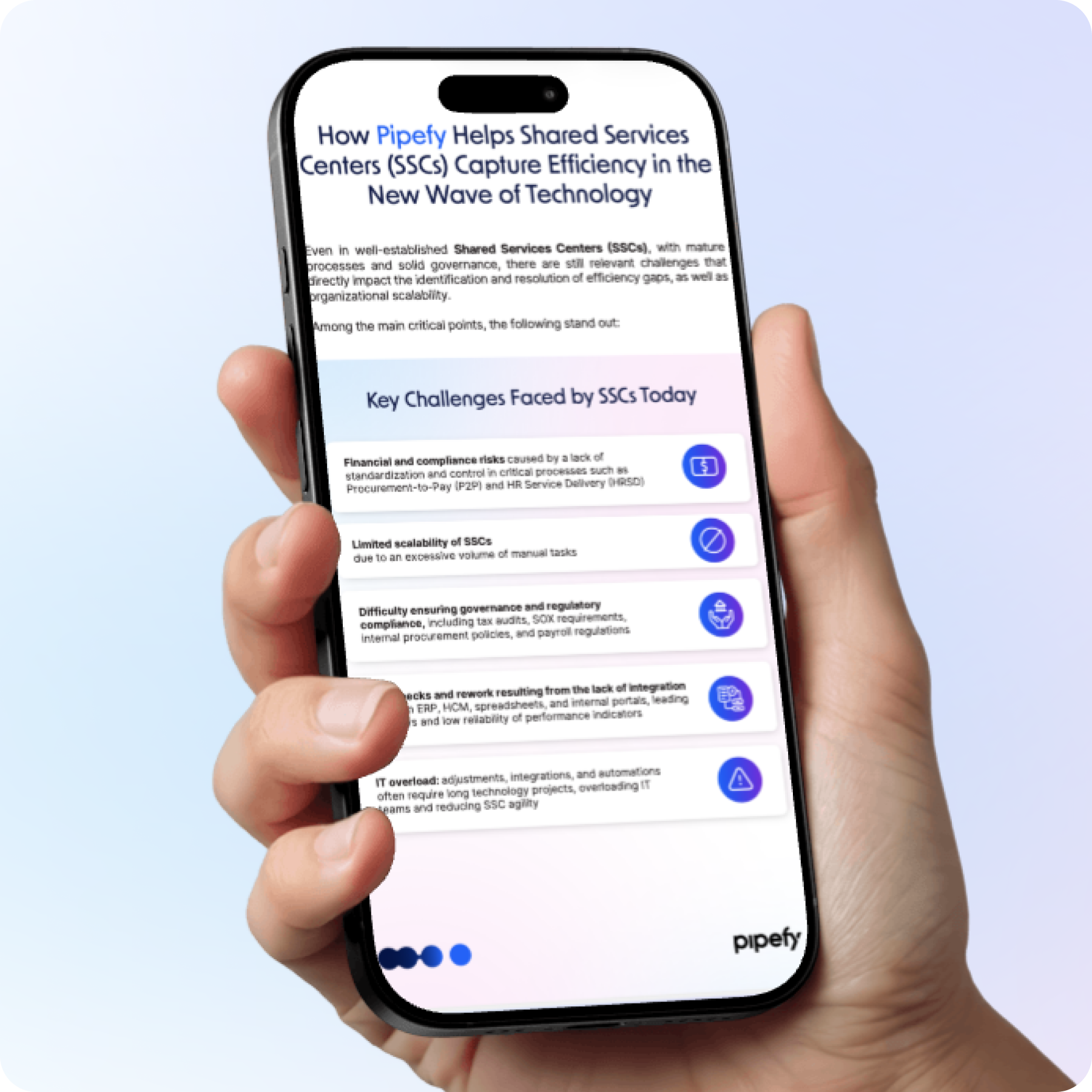
[One Pager] How Pipefy Helps Shared Services Centers (SSCs) Capture Efficiency in the New Wave of Technology
Why “just replace the ERP” is the wrong fix for procurement gaps
When procurement underperforms, replacing the ERP can feel like the decisive move. In practice, it is the slowest and most expensive way to fix a problem the ERP was never meant to solve.
An ERP is built to record transactions: purchase orders, invoices, ledgers. It is not built for the human, cross-functional work that happens before a PO exists, such as intake, supplier quoting, negotiation, and approvals. That work falls back to email and spreadsheets, no matter how capable the ERP is.
The data supports this. According to McKinsey, only 60% of large and 30% of small organizations even have a procure-to-pay system, and where P2P is in place it remains underleveraged. The gap is not a missing ERP, it is a missing layer between the request and the system of record.
Replacing the ERP does nothing for that layer. It consumes budget and years, disrupts the operation, and leaves the same manual sourcing process running on a newer database. The better move is to orchestrate the work around the ERP.
There is also an opportunity cost. Every quarter spent on a migration is a quarter the same manual sourcing keeps leaking savings and time. An ERP modernization may make sense on its own merits, but it is the wrong instrument for the procurement problem, and it should not hold procurement improvements hostage.
Put side by side, the trade-off between the two paths is hard to miss:
| Dimension | Replacing the ERP | Procurement orchestration (on top of the ERP) |
| What it actually fixes | Modernizes the transactional database; the manual sourcing layer still runs on email and spreadsheets | Fixes the intake, quoting, and approval layer the ERP was never built to handle |
| The manual sourcing layer | Unchanged, still manual on a newer database | Automated and governed in one flow, with AI Agents on the repetitive work |
| System of record | Replaced by a new ERP | Untouched; SAP, Oracle, or NetSuite stays the system of record |
| Time to value | Months to years of migration | Weeks, not a multi-quarter program |
| Cost profile | New licenses, implementation, and years of consulting | A no-code layer the procurement team runs itself, with no rip-and-replace bill |
| Disruption and risk | High; a big-bang cutover puts the systems of record at risk | Low; phased by site, with nothing migrated or ripped out |
| Ownership and rollout | IT-led, as a company-wide program | Procurement owns the rules, rolled out site by site |
Everything that follows unpacks that second column, starting with what orchestration actually does.
What procurement orchestration does that an ERP was never built to do
Procurement orchestration is the layer that runs the process the ERP does not. It captures requests, routes approvals, runs supplier quoting, applies policy, and pushes the final decision into the ERP as a clean transaction.
Think of it as an orchestration layer over the tools you already use. Instead of a stack of point tools and spreadsheets bridged by email, one flow connects intake, sourcing, approvals, and payment, with the ERP as the system of record underneath.
This is different from bolting on another point tool or a set of RPA scripts. Point tools add one more system to reconcile, and scripts break when a screen or a field changes. An orchestration layer models the whole process, so the flow, the rules, and the data stay coherent as the operation evolves.
This is the idea behind Pipefy’s P2P AI Studio: consolidating a sprawling procurement stack into one governed flow that sits on top of the ERP you already run. On top of that flow, AI Agents take on the repetitive work, from requesting and comparing quotes to checking compliance and running negotiation rounds.
The results follow. With Pipefy, orchestrating P2P this way makes the purchasing process up to 99% faster from request to approval, from around 20 days to minutes, delivers 7x greater efficiency in negotiations, and keeps 100% traceability across every step.
- Learn more: for the full workflow, the guide on procurement workflow automation breaks down each stage from intake to payment.
Getting spend and process visibility across multiple locations and business units
For a single site, spreadsheets are survivable. Across multiple locations, plants, or business units, they become a blind spot. Each site runs its own process, its own approvers, and often its own ERP instance, so no one has a single view of what the company is buying, from whom, and at what price.
This is the reality of decentralized procurement, and it is where visibility breaks down. Deloitte’s 2025 Global Chief Procurement Officer Survey points to tech fragmentation, organizational silos, and poor data as the barriers procurement has to overcome, the same fragmentation that hides savings and risk across sites.
An orchestration layer addresses this without centralizing every system. Requests from any location enter the same standardized flow, and the data rolls up into one place. That is how a company gains real procurement visibility: a live picture of every request, quote, and approval across sites.
That single view changes what leadership can do. Instead of chasing status location by location, teams consolidate demand, rationalize suppliers used redundantly across sites, and apply one approval policy everywhere, while local teams keep the autonomy to run their own requests.
The same applies to money. With every sourcing event in one flow, spend visibility becomes continuous instead of a quarter-end reconstruction, so leaders can benchmark pricing across locations, spot off-contract purchases, and catch maverick spend early.

- Read more: RFQs and Supplier Quoting Without Spreadsheets: How to Automate Procurement Intake and Approvals
Where human-in-the-loop fits: what to automate and where people stay in control
For a CIO, automation raises an immediate question: which decisions go to software, and where do people stay in control? In a well-designed operation, human-in-the-loop is not a brake on automation, it is what makes automation safe to trust.
The principle is to automate the repetitive, agentize the analysis, and keep people on the calls that carry judgment or a relationship:
- Automate: intake capture, routing, reminders, and low-value approvals within policy.
- Agentize: quote comparison, compliance checks, negotiation rounds, and outlier detection.
- Keep human: final award decisions, exceptions and over-threshold approvals, and key supplier relationships.
For the person signing off, this is what turns AI from a risk into an asset. The question stops being whether the automation can be trusted and becomes how much of the routine it can safely absorb, with the audit trail proving the answer.
Every agent action is logged, every policy check is enforced, and sensitive cases route to a person with the full context attached.
- Learn more: when an approver needs a change, a structured back-and-forth keeps the request moving without losing the thread, a pattern the Pipefy Community documents in its guide on back-and-forth approval flows.
The outcome is speed with a complete audit trail, which is exactly what the person signing off needs to see.

- See also: SRM and Risk Assessment: How Supplier Risk Management Supports Faster, More Reliable Risk Decisions
How this connects to SAP, Oracle, or NetSuite, without a migration project
The technical objection is fair: does another layer mean another integration headache? Done right, no. Procurement orchestration connects to the ERP through APIs, native connectors, or iPaaS, and the ERP stays the system of record. Nothing is migrated, and nothing is ripped out.
In practice, the orchestration layer reads and writes the data the ERP owns, such as vendors, cost centers, and purchase orders, so the two stay in sync without duplicate entry. Each site can keep its own SAP, Oracle, or NetSuite instance while the sourcing process above them is standardized and shared.
Success story: ZEISS automates 70+ processes no-code and boosts productivity
ZEISS is a clear example. The global optics leader already ran robust enterprise systems, SAP included, yet critical processes like purchasing still lived in spreadsheets and email, with little visibility or control.
Rather than replace those systems, ZEISS added Pipefy as a no-code orchestration layer to run the work around them, integrating with in-house tools and bots in the purchasing flow.
The results are concrete: purchasing lead time dropped from 30 days to 7.5 days, the same team now handles nearly 50% more orders per hour, and across more than 70 no-code processes ZEISS saves over 760 hours every month, without replacing SAP.
We needed to have flexibility. The request form for one area has to be one way, the one for another area needs to be another. I think the ease of leaving things exactly as we need them was Pipefy’s main point. It’s like assembling Lego blocks.
Lygia Silva
Business Process Manager | ZEISS
The rollout can also be phased by site. One location goes live on the orchestration layer while the others keep running as they are, so there is no big-bang cutover and no risk to the systems of record. Each site connects when it is ready.
What to evaluate before you commit: governance, audit trail, and total cost
For a decision at this level, the checklist is less about features and more about control and cost. Before committing to a procurement orchestration platform, evaluate:
- Governance: role-based access, explicit policy rules, and human approval on sensitive steps.
- Audit trail: every request, quote, approval, and agent action logged and exportable.
- Integration without lock-in: open connectivity to your ERP and existing tools, so you are never trapped.
- Total cost of ownership: implementation, maintenance, and change combined, weighed against a no-code layer that business teams run themselves.
- Time to value: measurable results in weeks, not a multi-quarter program.
On cost, the comparison that matters is not orchestration versus doing nothing, but orchestration versus an ERP replacement or a heavy custom build. A no-code layer that the procurement team configures itself avoids both the license bill and a permanent consulting dependency.
The timing favors acting now. The Hackett Group’s 2026 Procurement Key Issues Study reports that AI adoption in procurement has nearly doubled year over year, with AI-enabled technology ranked the number one factor expected to drive transformational impact on the function. Orchestrating P2P is becoming the standard, not the experiment.
See procurement orchestration on your own stack with Pipefy
You do not have to choose between fixing procurement and protecting the ERP investment you already made. Procurement orchestration gives multi-site teams the visibility, automation, and governance they need, on top of SAP, Oracle, or NetSuite, not instead of them.
To see how Shared Services Centers are capturing that efficiency across procurement and beyond, download this exclusive one-pager, “How Pipefy Helps Shared Services Centers (SSCs) Capture Efficiency in the New Wave of Technology.”
Inside, you will find:
- The efficiency gaps that still slow even mature Shared Services Centers.
- How Pipefy’s AI orchestration layer connects legacy systems without replacing them.
- High-impact use cases across HR, Finance, Legal, IT, and Marketing.
- P2P automation in practice, from quoting and validation to negotiation.
- A real customer case, with the ROI, hours saved, and faster response times it delivered.
[One Pager] How Pipefy Helps Shared Services Centers (SSCs) Capture Efficiency in the New Wave of Technology