ARTICLE SUMMARY
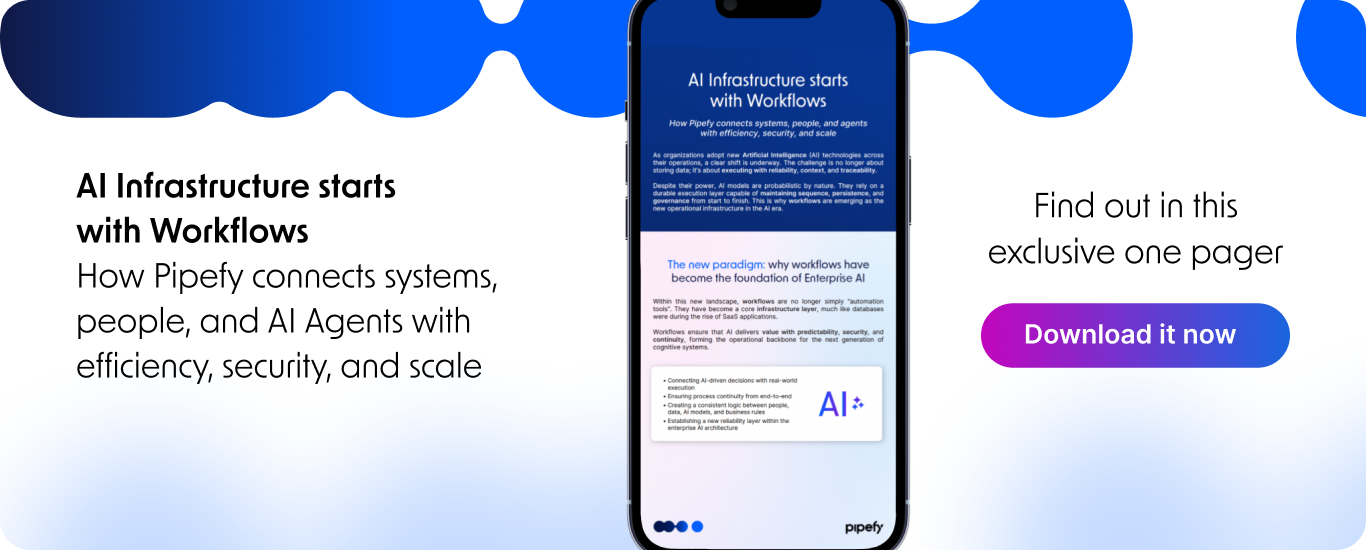
Discover how workflow automation is redefining enterprise infrastructure in the age of AI and intelligent orchestration.

For decades, databases have served as the invisible foundation of digital systems, the silent layer ensuring reliability and structure behind every SaaS (Software as a Service) application.
Today, that foundation is shifting. In the era of AI-driven operations, the new backbone of enterprise reliability is workflow automation, now enhanced by AI Agents operating within structured business processes.
As organizations embed AI across processes, the challenge is no longer storing data. It’s executing actions intelligently and consistently across dynamic systems. That’s why workflow automation has emerged as the durable execution layer connecting data, business rules, systems, and AI-driven decision-making.
In this article, we explore how workflow automation is becoming the new “database” of enterprise operations, why it’s essential for intelligent orchestration, and how it supports scalable, AI-ready infrastructures across industries.
From Static Data to Dynamic Execution
During the SaaS era, relational databases became the essential infrastructure for storing and retrieving structured information. They powered CRMs, ERPs, and financial platforms, ensuring data integrity and consistency.
But as automation and AI matured, the bottleneck moved from data storage to process execution. Modern enterprises now depend on hundreds of cloud tools and APIs, each requiring synchronization, retries, and context persistence.
In this environment, workflow automation acts as the infrastructure for stateful execution, providing the structured context where AI Agents can analyze, decide, and act reliably.
A workflow automation platform provides exactly that: an intelligent orchestration layer that ensures every task runs to completion, survives errors, and adapts dynamically, much like databases once ensured every record was written correctly.

Why Workflow Automation Is the New Database
This shift doesn’t replace databases — it expands their role. While databases ensure data durability, workflows ensure execution durability.
Let’s compare them side by side:
| Capability | Databases | Workflow Automation |
| Core Function | Store and query data | Execute and orchestrate processes |
| Durability | Ensures data persistence | Ensures process continuity |
| Scope | Systems of record | Systems of execution |
| Reliability | Data integrity | Execution consistency |
| Intelligence | Query optimization | Embedded AI, AI Agents, and governed orchestration |
| Governance | Data consistency rules | Business rules, human-in-the-loop review, and full observability |
In short, workflow automation transforms static systems into living, connected infrastructures.
According to McKinsey, companies combining AI and automation in operations are achieving up to 40% faster process execution and 30% higher compliance accuracy. This happens because workflows act as the connective tissue linking AI decisions with real-world actions.
Read more: Business Performance: 5 Practical Ways to Improve It with AI in 2025
The Role of Workflow Orchestration in AI Infrastructure
AI models are inherently stateless. They generate probabilistic outputs without persistence or auditability. To be reliable, those outputs must be orchestrated into consistent, traceable processes. This is where workflow orchestration becomes indispensable.
Workflow orchestration ensures that:
- Every AI-driven action follows a reliable sequence and context
- Failures trigger automated retries or escalation to human validation
- Parallel workflows run without interference or data loss
- Compliance and visibility are maintained through auditable logs
Without workflow automation, AI remains isolated, generating outputs without accountability or traceability. When embedded within structured workflows, AI Agents operate with context, business rules, escalation logic, and human supervision, transforming isolated intelligence into governed execution.
According to Gartner, by 2026, 80% of enterprises will rely on AI-enabled orchestration frameworks to coordinate automation across distributed systems. This marks a structural transformation: workflow engines are becoming as fundamental to AI as databases were to SaaS.

End-to-End Orchestration: From Intake to Execution
Traditional automation focuses on isolated tasks. Modern enterprises, however, need end-to-end orchestration, the ability to connect intake, decision, and execution into a single continuous flow.
So, in response, workflow automation platforms, such as Pipefy, are evolving into AI-powered orchestration hubs, environments where structured workflows and AI Agents operate together under governance.
They combine:
- Structured workflow automation: Clear phases, SLAs, and business rules
- AI Agents embedded in processes: Capable of analyzing documents, detecting anomalies, and executing decisions
- Human-in-the-loop controls: Enabling review, intervention, and escalation
- Real-time observability: Detailed logs of every action taken across phases
- Native integrations and API orchestration: Connecting systems of record and external tools
Together, these capabilities enable intelligent workflows that learn and improve over time.
A report from Deloitte found that enterprises integrating Embedded AI into workflow orchestration improved productivity by up to 45% and reduced manual rework by more than half.
Database vs Workflow: A New Definition of Reliability
The idea that “workflows are the new databases” doesn’t diminish the importance of databases; it redefines reliability.
- Databases keep information consistent
- Workflows keep execution consistent
And when enhanced by AI Agents, workflow automation ensures not only consistency, but adaptive, context-aware execution at scale.
Enterprises once optimized for data centralization. Now, they optimize for distributed orchestration, ensuring that every process can resume, recover, and complete autonomously.
This new reliability layer, supported by workflow automation platforms, allows teams to operate with confidence even in high-volume, AI-integrated environments.
Among the platforms leading this transformation, Pipefy stands out as a low-code/no-code workflow automation platform that merges structured processes, AI Agents, and governance in a unified execution environment.
Through its system of AI Agents, Pipefy embeds context-aware intelligence directly into workflow automation, enabling autonomous task execution, anomaly detection, and real-time decision support, always within defined business rules and supervision controls.
Unlike standalone AI tools, Pipefy’s AI Agents operate inside structured workflows. Every action is logged, traceable, and auditable, eliminating the “black box” effect and ensuring transparency across operations.
The platform bridges the long-standing gap between IT and business operations, enabling teams to build and optimize workflows up to four times faster, using natural language and no-code interfaces.
Scalable Automation Across Industries
From financial services to insurance and consumer goods, scalable automation is the common denominator of digital transformation.
- Financial institutions use workflow automation to accelerate KYC, fraud detection, and policy management, maintaining traceability across systems. AI Agents embedded within workflow automation help validate documents, cross-check data across internal and external systems, and trigger escalations automatically when anomalies are detected.
- Insurance companies leverage workflow automation enhanced with AI Agents to orchestrate claims management, underwriting, policy administration, and fraud prevention, accelerating decisions while maintaining compliance and auditability.
- Consumer goods enterprises orchestrate HR and procurement workflows through intelligent workflows, adjusting supply chain operations based on predictive AI insights.
This convergence between orchestration, AI, and automation defines the operational DNA of modern enterprises — adaptable, compliant, and continuously improving.
How Pipefy Enables Enterprise Orchestration
In the AI-driven era, workflow automation is no longer just about automating tasks. It is about enabling intelligent, collaborative, and transparent execution, where humans and AI Agents work together to deliver measurable operational impact.
Pipefy is the workflow automation platform that turns fragmented operations into connected, intelligent orchestration.
By leveraging end-to-end orchestration, organizations can model, automate, and monitor complex workflows, uniting people, systems, and AI within a single governed environment. Its Embedded AI and Agentic AI capabilities let workflows make real-time decisions, detect anomalies, and learn from execution data, all without coding.
Enterprise-grade governance, including RBAC, SSO, MFA, encryption, audit trails, and strict data protection agreements, ensures workflow automation and AI Agents operate securely within your organization’s business rules and compliance requirements.
As an AI Enabler, Pipefy empowers business teams to design and evolve workflows autonomously, while IT retains full governance.
Discover how workflow automation enhanced with AI Agents can transform your operations: